

The Shendai Melodic Drums
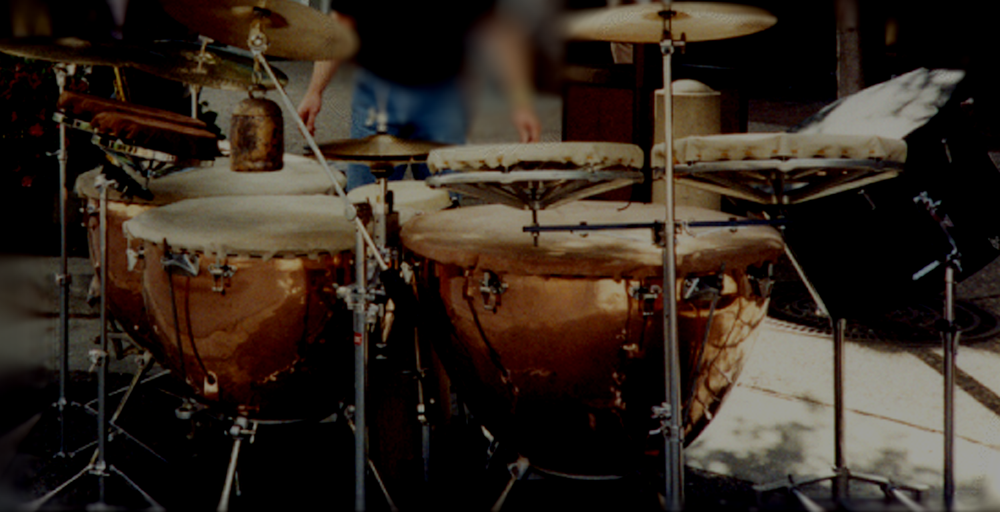
The Shendai Melodic Drums (also known as the Shendai Ceremonial Drums) are a one-of-a-kind and sonically unique creation that evolved from a single wish... the quest for a certain special instrumental sound and sense. It was a sound that I had never before heard in any music.
After many rewarding years playing fine jazz using a standard "traps" drum set, suddenly in the late 1980s I found myself longing for something else musically - for some new or different form of musical expression - perhaps an instrument that was "softer" or more melodic. I had for some time been humming to myself certain melodic rhythmic patterns, often based in unusual time signatures, and playing these patterns would require an instrument or collection of instruments with definite pitch. Thus the quest was begun.
_____________________________
The Original Shendai Set
After auditioning many kinds of hand drums, ethnic instruments, and some mallet percussion instruments like vibraphone and marimba, I was still dissatisfied. I was just not finding the sound and character I was seeking in any existing instrument, and I eventually decided that the only solution was to create my own.
The first attempt to do so centered around a set of three orchestral timpani drums (kettle drums) chosen mainly because they had great range, and were easily tunable and re-tunable to specific pitches. Because of the multi-pitched patterns I wished to play, I thought I would have to do some of this re-tuning between takes, or even "on the fly", and the timpani would allow me to retune quickly if needed. But to get the sound character I wanted, the natural timbre of the heavy copper-bowled timpani would have to be changed considerably.
I began constructing special mallets from various materials, and experimenting with both organic and synthetic covering materials to dampen or partially dampen the timpani heads, thereby altering their harmonics and timbre, with varying degrees of success. The picture above is from this period, showing me with an early version of what eventually became the full Shendai set. Unfortunately, many later and more elaborate versions of the set went unphotographed.
More Taiko-like
By 1995 several smaller tunable drums had been added to provide higher pitches, and after more work with various drum head materials and mallets, I was finally able to produce a consistently desirable timber across the full range of all sizes of drums. Sometime after I had already constructed and more-or-less perfected this instrument I became acquainted with Japanese Taiko Drumming, and only then realized that what I had unknowingly created was, in essence , my own personal version of a Taiko drum set.
Besides the extra drums, LOTS of brass percussion instruments had also been added in the form of gongs, bells, chimes, cymbals, and miscellaneous sonic tools, even including a brass crank doorbell! At this point the full set stretched nearly twelve feet across and looked like a veritable forest of stands on stage, and I was pressed to develop some interesting new dance skills and special approaches to music-making to accommodate this cluster of instruments, even devising a method to play some of the brass bells with my knees.
Midi and Electronic Sounds
The set then numbered about 45 playing surfaces, and at one time included midi trigger devices, opening the door to the use of electronic percussion and other synthesized sounds. But the midi percussion controllers of that era were resistant to being played with my soft mallets, and made their own clicking sounds when struck - not helpful when recording acoustically. In the end the electronics proved too difficult to integrate smoothly and musically with the acoustic drums, and were finally set aside, only to return twenty years later, as Harrison and I have recently begun work on a new generation of our music which utilizes more modern electronics. Watch our coming newsletters for more on this.
Meanwhile... with the timpani as the basis of the Shendai set, traveling was a bit difficult because of their bulk and weight. By the time of the recording sessions for Tales of Kings, I had developed a more compact, "studio" version of the set by setting aside the timpani and keeping only the other core essentials and the best-sounding small components. This new incarnation used only eight single-headed pitched drums ranging in size from 6 to 22 inches, and about a dozen carefully selected cymbals, bells, gongs, and other suitably pitched brass instruments. This made it much easier to transport and manage the set physically, while still keeping enough variety of sounds available for a comfortable range of musical expression. But other components of the full set, including the timpani, still wait in the wings for their next grand performance opportunity.
- Steven Miller, updated June 2020.
